

Why Does Some Matcha Taste Bitter? Fixes & Causes
Table of Contents
- The Real Reasons Matcha Tastes Bitter
- Matcha Water Temperature Guide: Why Boiling Water Ruins Your Cup
- Ceremonial Grade vs Culinary Grade Matcha: What the Label Really Means
- Whisking, Sifting and Aeration: Technique That Changes Bitterness
- How to Store Matcha to Keep It Fresh
- Troubleshooting Specific Bitter Profiles
- Frequently Asked Questions
Last Updated: September 11, 2026
The Real Reasons Matcha Tastes Bitter
If your morning matcha taste bitter rather than sweet and grassy, the culprit is almost never the matcha itself. It's how it was brewed, stored, or chosen. This guide breaks down exactly why some matcha tastes bitter and what you can do about it, starting with the chemistry inside the leaf.
Matcha taste bitter when three things go wrong: water that's too hot, powder that's degraded, or a grade of matcha that was never meant to be drunk straight. Fix those three, and most bitterness disappears. Below, we'll show you the exact temperature, whisking, and storage fixes that can transform a harsh cup into a smooth one.
Matcha bitterness is the result of polyphenols and catechins being over-extracted, while the amino acids that balance them are destroyed by heat or time.
How Polyphenols, Amino Acids and L-Theanine Shape Flavour
Bitter matcha comes down to a tug-of-war between two groups of compounds. Polyphenols, including catechins and tannins, deliver astringency and bitterness. Amino acids, especially L-theanine, deliver sweetness and umami. When the balance tips toward polyphenols, you taste bitterness; when it tips toward L-theanine, you taste a smooth, savoury cup.
Shade-grown matcha, like the leaves used in Whisk Away Matcha, develops more L-theanine because shading slows the conversion of amino acids into catechins (peer-reviewed research). That's why ceremonial-grade matcha from shade-grown Japanese fields tastes sweeter than sun-grown leaves.

Matcha Water Temperature Guide: Why Boiling Water Ruins Your Cup
Boiling water is the single fastest way to ruin matcha, but the reason is more specific than 'it burns the tea'. Heat drives two competing extraction reactions at once. Catechins and tannins, the polyphenols responsible for astringency, become more soluble as temperature rises, so hot water pulls them out of the powder aggressively. L-theanine and other free amino acids, which supply sweetness and umami, are heat-sensitive and degrade above roughly 80°C (PubMed). The result is a cup where the bitter compounds are amplified and the balancing compounds are diminished at the same time. That double effect is why a few degrees makes a visible difference in the cup.
The ideal range sits between 70°C and 80°C. For a traditional usucha (thin tea), aim for about 75°C. For koicha (thick tea), drop to around 70°C. If you don't have a thermometer, boil the kettle, then pour the water into a second cup and wait two to three minutes before using it. A common pattern is that a 5°C drop noticeably softens the finish, so if your cup still bites at 80°C, try 75°C before changing anything else.
| Water Temperature | Result | Best For |
|---|---|---|
| 60-70°C | Sweet, delicate, low bitterness | Koicha, premium ceremonial grade |
| 70-80°C | Balanced umami and sweetness | Usucha, daily drinking |
| 80-90°C | Noticeable astringency | Blended lattes with milk |
| 100°C (boiling) | Harsh, scorched, very bitter | Avoid entirely |
Water Chemistry: The Variable Most Guides Ignore
Temperature is only half the story. The mineral content of your water changes how readily tannins and catechins are extracted, and this is the factor almost every brewing guide skips.
Hard water, high in calcium and magnesium, binds to polyphenols and can push astringency forward, making even a correctly brewed cup taste sharper. Very soft or distilled water, at the other extreme, lacks the minerals that buffer extraction and can produce a flat, hollow cup where bitterness reads as harsh rather than rounded. Most practitioners find that moderately soft filtered water, with some mineral content retained, gives the most balanced extraction.
If your tap water is heavily chlorinated, the chlorine itself contributes an off, medicinal edge that many people misread as bitterness. A simple carbon filter removes it. If you already filter your water and your matcha still tastes harsh, try a low-mineral bottled water before blaming the powder, the change in the cup can be immediate.
The Japanese Tea Association's brewing guidance confirms that lower temperatures preserve L-theanine and reduce catechin extraction.
Ceremonial Grade vs Culinary Grade Matcha: What the Label Really Means
Ceremonial grade and culinary grade matcha are not marketing fluff. They reflect the harvest time, leaf quality, and intended use. Ceremonial grade uses the youngest first-harvest leaves, de-stemmed and de-veined, then stone-ground into a fine, vibrant green powder meant to be whisked with water alone. Culinary grade blends later-harvest leaves and is designed to stand up to milk, sugar, and baking.

If you've been drinking culinary-grade matcha straight and wondering why it tastes bitter, that's the answer. It was never built for that. Culinary grade is intentionally more astringent and earthy so its flavour survives in lattes and desserts.
| Feature | Ceremonial Grade | Culinary Grade |
|---|---|---|
| Harvest | First flush, youngest leaves | Later harvests |
| Colour | Vibrant green | Yellowish-green |
| Flavour | Sweet, umami, low bitterness | Earthy, astringent |
| Best for | Drinking with water | Lattes, baking, smoothies |
| Price | Higher | Lower |
Whisking, Sifting and Aeration: Technique That Changes Bitterness
Whisking technique changes how bitter matcha tastes because it controls how evenly the powder disperses in water. Clumps of dry matcha hit your tongue as concentrated bursts of astringency, which reads as bitterness. Proper aeration, achieved with a bamboo whisk (chasen), breaks up clumps and creates a fine foam that softens the mouthfeel.
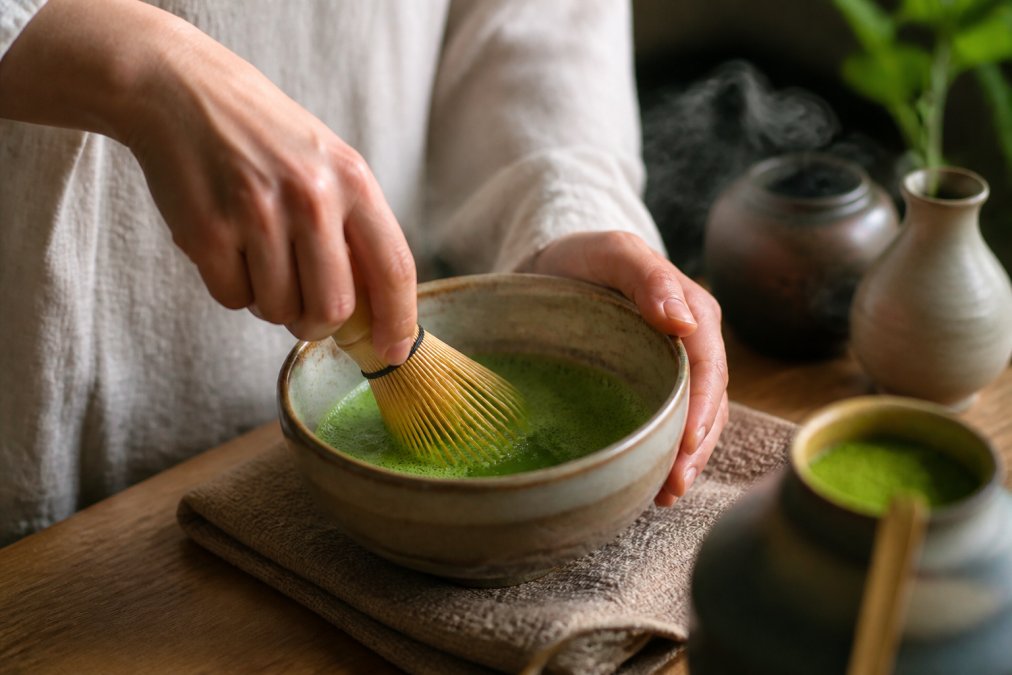
Sift your matcha through a fine mesh strainer before adding water. This one step eliminates most clumping. Then whisk in a "W" or "M" motion, not a circular stir, using your wrist rather than your whole arm. The goal is a smooth suspension with a light, even foam on top, not a frothy mess.
A common mistake is adding all the water at once. Start with a small splash, whisk into a paste, then add the rest. This prevents dry pockets and gives you a smoother, less bitter cup.
How to Store Matcha to Keep It Fresh
Matcha is fragile because it is a whole-leaf powder, not an infusion. Every particle is exposed to air, so oxidation begins the moment the seal is broken. The chemistry is straightforward: oxygen reacts with the catechins and chlorophyll in the powder, converting the bright green pigments into duller compounds and shifting the flavour from sweet and grassy toward flat, stale, and eventually bitter. Light accelerates the same reaction, and heat speeds it up further. Moisture is the fourth variable, it causes clumping and creates conditions for spoilage.
The practical rules follow from that chemistry:
- Oxygen: the primary driver of oxidation and off-flavours. Squeeze air out of pouches before resealing.
- Light: degrades chlorophyll and turns powder yellowish-green. Store in opaque containers, not clear jars.
- Heat: accelerates every other degradation pathway. Keep away from stovetops and sunny benches.
- Moisture: creates clumping and spoilage. Keep the container sealed and dry.
- Strong odours: matcha absorbs surrounding smells easily because the powder has a large surface area.
If you buy matcha in a resealable pouch, squeeze out the air before sealing and use it within a few weeks of opening. For longer storage, keep the sealed container in the fridge and let it come to room temperature before opening to avoid condensation forming on the powder. Condensation is a common and under-discussed cause of clumping, the temperature swing between fridge and bench is enough to introduce moisture every time you open the tin.
Diagnosing Stale Bitterness vs Other Bitterness
Stale bitterness has a distinct signature, and learning to recognise it saves you from adjusting the wrong variable. Where heat-damaged matcha tastes sharp and scorched, and culinary-grade matcha tastes drying and astringent, oxidised matcha tastes dull and flat with a lingering cardboard or hay-like note. The colour is the giveaway: fresh ceremonial matcha is vibrant, almost neon green, while oxidised powder fades to a muted olive or yellowish-green.
A quick freshness test: rub a pinch between your fingers. Fresh matcha feels silky and smells sweet and grassy. If it smells dusty, looks dull, or clumps without being wet, oxidation has already set in and no brewing adjustment will bring the sweetness back.
Once oxidation has progressed, the damage is irreversible. The fix is prevention, not correction: buy in smaller quantities you will finish within a few weeks, reseal immediately after each use, and treat the fridge as a tool for unopened stock rather than daily storage.
Troubleshooting Specific Bitter Profiles
Not all bitterness tastes the same, and the fix depends on which type you're getting. Use this guide to match your cup's flavour to its cause.
| Bitter Profile | Likely Cause | Fix |
|---|---|---|
| Harsh, scorched, sharp | Water too hot | Cool to 70-80°C |
| Dry, chalky, clumpy | Powder not sifted | Sift before whisking |
| Dull, flat, stale | Oxidation from poor storage | Airtight container, fridge |
| Astringent, drying | Culinary grade used for drinking | Switch to ceremonial grade |
| Earthy and grassy | Late-harvest leaves | Try first-flush ceremonial matcha |
| Bitter only at the end | Over-whisking or too little water | Add water, whisk gently |
If you've adjusted temperature, sifting, and storage and your matcha still tastes bitter, the grade is the issue. Ceremonial-grade matcha from shade-grown Japanese fields, such as JAS Certified Organic varieties, is stone-ground from whole leaves and delivers the sweet, umami-forward profile most people are chasing.
The "acquired taste" curve is real too. Matcha is less sweet than coffee or tea with milk, and your palate may adjust over time with daily drinking. If your first cup tastes bitter, don't give up. Adjust your brew and give it a week.
Frequently Asked Questions
Is it normal for matcha to taste bitter?
Some bitterness is normal because matcha contains tannins and catechins. But if your matcha tastes sharply bitter or astringent, it usually means the water was too hot, the powder was low grade, or the matcha was old. A well-made ceremonial grade matcha should taste smooth with grassy, umami notes and only a faint bitterness in the background. Adjusting your water temperature and using fresher powder makes a noticeable difference.
What should I do if my matcha is too bitter?
Try three things in order. First, cool your water to around 70-80°C instead of using boiling water. Second, sift the powder to remove clumps so it disperses evenly. Third, whisk briskly in a zigzag motion for 15-20 seconds to build a fine foam. If it still tastes harsh, your matcha may be culinary grade or past its shelf life. A fresh ceremonial grade powder may offer a smoother taste.
Does water temperature affect matcha bitterness?
Yes, significantly. Water above 85°C pulls out tannins and catechins quickly, which creates a sharp, astringent taste. Water between 70-80°C extracts the amino acids and L-theanine that give matcha its natural sweetness and umami. If you do not have a thermometer, boil the kettle and let it sit for 3-5 minutes before pouring. This single change often fixes a bitter cup on its own.
How can you tell if matcha has gone bad?
Fresh matcha has a vibrant green colour and a sweet, grassy smell. If the powder looks dull, yellowish-green or brownish, and smells flat or hay-like, it has oxidised and lost its flavour. Matcha stored in an airtight container away from light and heat keeps well for about 4-6 weeks after opening. Beyond that, bitterness increases and the umami fades. Buying smaller quantities more often is better than stocking up.
Bitterness in matcha is almost always fixable, and it usually comes down to temperature, technique, or grade rather than the powder itself. If you're ready to taste matcha the way it's meant to be, Whisk Away Matcha offers JAS Certified Organic, stone-ground matcha sourced directly from Kagoshima and Uji, Japan, with a smooth, vibrant flavour and minimal bitterness. Get started with Whisk Away Matcha and enjoy calm, focused energy without the jitters or the harsh bite.