

Benefits of JAS Certified Organic Matcha: A 2026 Guide
Table of Contents
- What JAS Certification Means for Your Matcha
- Why Organic Matcha Beats Non-Organic: A Side-by-Side Look
- Ceremonial Grade Matcha Benefits: What You Get in Every Bowl
- How to Prepare Organic Matcha for a Calm, Focused Day
- Matcha vs Coffee Energy: Why the Crash Doesn't Happen
- Heavy Metals, Testing, and Storage: Protecting Your Organic Matcha
- Conclusion
- Frequently Asked Questions
Last Updated: September 10, 2026
What JAS Certification Means for Your Matcha
JAS Certified Organic matcha is matcha that has passed the Japanese Agricultural Standard (JAS) certification process, verifying that the tea leaves were grown without synthetic pesticides or fertilisers and processed in a certified organic facility. The benefits of JAS certified organic matcha start with this traceable chain of custody, from soil to stone-ground powder.
This guide walks through what that certification actually guarantees, how it compares with other organic labels, and what it means for your daily bowl.
JAS certification is administered under Japan's organic labelling system, which requires annual on-site inspections and documented field records (maff.go.jp). Australian buyers should also know that imported organic goods are regulated under the country's organic export and import framework, which recognises JAS as a compliant certification standard.
JAS vs. USDA Organic: What the Labels Actually Require
Both standards prohibit synthetic pesticides, but they differ in scope. JAS is a Japanese standard with a specific focus on tea cultivation and processing methods, while USDA Organic is a United States standard. JAS-certified matcha must meet Japanese inspection requirements, and the two certifications are recognised as equivalent under international organic trade arrangements, though the paperwork and audit trails are not identical.
For Australian buyers, the practical takeaway is this: JAS certification is the standard that originates where your matcha is actually grown. A JAS label reflects verification at the source.
Why Organic Matcha Beats Non-Organic: A Side-by-Side Look
Organic matcha is grown without synthetic pesticides, herbicides, or soluble fertilisers, and that single constraint cascades through the entire leaf. The difference is not just what is absent from the powder; it is how the plant is forced to grow, what it accumulates, and how the soil behaves across seasons.
What actually changes in the leaf
When a tea bush is fed synthetic nitrogen, it pushes rapid leaf growth. Fast growth dilutes the concentration of secondary metabolites, the catechins, chlorophyll, and L-theanine that make matcha worth drinking. Organic systems rely on composted organic matter and slower nutrient release, which tends to produce smaller, denser leaves with a higher concentration of those compounds per gram. This is one reason a well-made organic ceremonial matcha can taste sweeter and less astringent than a conventionally grown equivalent at the same harvest grade.
Pesticide residues: what the testing actually shows
Conventional tea cultivation in Japan is permitted to use a defined list of registered agricultural chemicals, with mandated pre-harvest withholding periods. Residues are not automatically present at unsafe levels, but the risk profile is different: there are more inputs, more application windows, and more variables between farms. Organic certification removes that class of input entirely, which simplifies the residue question, there is nothing to withhold because nothing synthetic was applied.
Soil health is a long game
Organic certification requires a documented conversion period before a field can be labelled organic (usda.gov). During that window, the soil biology rebuilds: microbial activity, mycorrhizal networks, and organic carbon all recover from conventional management. For perennial crops like tea, this matters because the same bushes are harvested for decades. A field managed organically for ten years is not the same field as one converted last season, even if both carry the same label today.
The comparison, honestly
| Factor | Organic Matcha | Non-Organic Matcha |
|---|---|---|
| Synthetic pesticides | Prohibited | Permitted within registered limits |
| Fertility source | Compost, organic matter | Soluble synthetic nitrogen common |
| Soil biology | Rebuilt over conversion period | Variable, often depleted |
| Traceability | Certified chain of custody | Often limited to processor level |
| Third-party testing | Required under certification | Variable, buyer-dependent |
| Leaf density | Typically smaller, denser leaves | Faster, larger, more diluted growth |
| Flavour | Cleaner, sweeter, less bitter | Can taste harsher or more astringent |
| Cost | Higher, lower yield, certification fees | Lower |
The trade-off is real. Organic farming yields less per hectare, and certification adds audit and inspection costs that flow through to the retail price. If price is your only criterion, non-organic wins on cost per gram. If you drink matcha daily and care about what accumulates in the leaf over years of consumption, organic is the more defensible choice, and the flavour difference is usually noticeable in a plain bowl of usucha.
Ceremonial Grade Matcha Benefits: What You Get in Every Bowl
Ceremonial grade matcha is made from the first harvest of shade-grown leaves, stone-ground into a fine powder. That first harvest concentrates the compounds that make matcha worth drinking: antioxidants, catechins, EGCG, and L-theanine.
Ceremonial grade matcha benefits centre on these compounds. Shade-growing boosts chlorophyll and L-theanine, which is why ceremonial matcha tastes less bitter and more umami than culinary grade (PubMed). Culinary grade is ground from later harvests and intended for baking and smoothies, where the flavour gets masked anyway.
How to Prepare Organic Matcha for a Calm, Focused Day
Preparing organic matcha takes about two minutes once you have the rhythm. Sift 1 to 2 grams of powder into a bowl, add roughly 60 to 70 millilitres of water at about 80°C, then whisk in a zigzag motion until a fine foam forms.
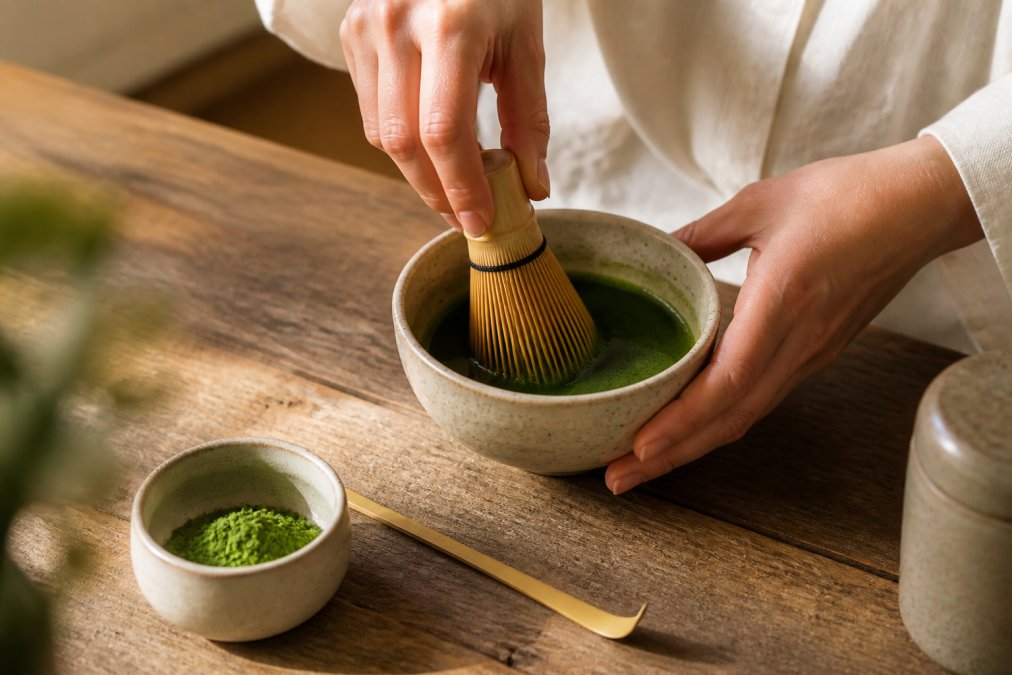
Steps:
- Sift the matcha to remove clumps
- Heat water to roughly 80°C, not boiling
- Pour water over the powder
- Whisk in a W or zigzag motion
- Drink while the foam holds
Boiling water is the most common mistake. It scorches the leaf and turns the bowl bitter. If you're coming from coffee, expect the ritual to feel slower at first. That slowness is part of how it works.
Matcha vs Coffee Energy: Why the Crash Doesn't Happen
Matcha vs coffee energy comes down to how caffeine is delivered. Coffee gives you a fast spike followed by a drop. Matcha releases caffeine gradually because the whole leaf is consumed, and L-theanine moderates the stimulant effect.
This is why many people describe matcha as calm, focused energy rather than a jolt. The caffeine is still there, just delivered with compounds that soften the edges. For a workday, that often means steadier concentration without the mid-afternoon slump.
Heavy Metals, Testing, and Storage: Protecting Your Organic Matcha
Certification answers one question: how was the leaf grown? It does not answer two others that matter just as much, what is in the leaf when it is tested, and what happens to it between the factory and your bowl. Most matcha content stops at the label. This section covers the two gaps the rest of the market skips.
Heavy metals: why tea plants are different
Tea is a perennial crop grown on the same ground for decades, and it is unusually efficient at taking up certain elements from soil. Lead, cadmium, and arsenic are the three that receive the most attention in Japanese tea testing, along with aluminium. The plant does not discriminate between a nutrient and a contaminant if the chemistry is close enough, cadmium, for example, is taken up through the same transport pathways as zinc.
This is why origin matters more than most buyers realise. Older industrial land, historically contaminated soil, and some volcanic or mineral-rich substrates can carry higher background levels of these elements even when no pesticide has ever been applied. Organic certification does not test for heavy metals as a condition of the label; it tests for the absence of prohibited inputs. Heavy metal testing is a separate, buyer-driven layer of quality control.
What a credible testing protocol looks like
A serious organic matcha supplier tests the finished powder, not just the raw leaf, because grinding and processing can introduce contamination from equipment. The practical markers of a robust protocol are:
- Testing at the batch level, not annually, so a single bad lot cannot be masked by a good one
- Testing the finished stone-ground powder for lead, cadmium, arsenic, and aluminium
- Using an accredited laboratory with a documented method and detection limits
- Publishing or sharing results on request, with batch numbers that match the packaging
Most reputable Japanese producers test to standards aligned with the Japanese Food Sanitation Act and, for export, to the importing country's requirements. If a brand cannot tell you which laboratory tested a specific batch and what the detection limits were, the "tested" claim is marketing, not verification.
Storage: how organic integrity degrades after the seal is broken
Here is the gap almost no competitor covers. A JAS-certified matcha can lose most of the qualities you paid for within weeks of opening if it is stored badly. The compounds that make organic matcha valuable, chlorophyll, catechins, L-theanine, are all sensitive to light, heat, oxygen, and moisture. Oxidation does not care that the leaf was grown organically.
The degradation is visible before it is tastable. Vibrant green turns olive, then dull yellow-brown, as chlorophyll breaks down. The umami fades, astringency rises, and the fine powder starts clumping as it absorbs moisture from the air. By the time it tastes stale, the antioxidant content has already dropped substantially.
Practical storage rules that actually protect the powder:
- Keep it sealed in an opaque, airtight container, the original foil pouch resealed tightly is usually better than a decorative tin
- Store in the fridge, not the freezer, unless you plan to keep it unopened for months; repeated freeze-thaw cycles introduce moisture
- Let the container come to room temperature before opening, so condensation does not form on the powder
- Keep it away from coffee, spices, and anything strongly scented, matcha absorbs odours readily
- Use within a few weeks of opening for peak flavour and colour; within two to three months at most for everyday drinking
Conclusion
The challenge with organic matcha is that certification claims are hard to verify from the outside, and quality varies widely between brands. Whisk Away Matcha sources JAS Certified Organic matcha directly from Kagoshima and Uji, stone-ground from whole shade-grown leaves, so the certification, the origin, and the processing all line up. As an Australian-owned brand, we provide a premium experience that helps you slow down and reconnect with yourself, one intentional cup of whole-leaf green tea at a time. Get started with Whisk Away Matcha and make your morning bowl something worth slowing down for.

Frequently Asked Questions
What does JAS certification actually mean for matcha quality?
JAS certification means the matcha meets the Japanese Agricultural Standard for organic production. It covers how the tea is grown, processed, and handled, including rules on soil health, no synthetic chemicals, and traceability from farm to package. For buyers, it is a verifiable signal that the product has been checked against a defined standard rather than relying on marketing claims alone.
Does organic matcha have health benefits compared to non-organic?
Organic matcha is grown without synthetic pesticides or fertilisers, which reduces your exposure to chemical residues. It still delivers the same core compounds, including catechins like EGCG, L-theanine, and chlorophyll. The main difference is what is not in the leaf. If you drink matcha daily, choosing a JAS certified organic option is a simple way to limit cumulative intake of synthetic chemicals.
How does matcha vs coffee energy differ throughout the day?
Coffee delivers a sharp caffeine spike that many people feel fade into an afternoon crash. Matcha contains caffeine alongside L-theanine, an amino acid that supports a steadier release of energy. The result is typically a calmer, more sustained focus over several hours rather than a quick peak. If you are used to three espressos by lunchtime, matcha may feel gentler but longer-lasting.
Is there a downside to drinking matcha every day?
For most people, daily matcha is well tolerated. Because matcha uses the whole leaf, you consume more caffeine per gram than steeped green tea, so keep total daily caffeine in mind. Some people are sensitive to caffeine or to the tannins in tea. If you take medication or have a health condition, check with your doctor before making it a daily habit.