

Buy Organic Matcha for Latte: 2026 Buying Guide
Table of Contents
- Why Organic Matcha Makes a Better Latte
- Ceremonial Grade vs Culinary Grade Matcha: Which Belongs in Your Latte?
- How to Make a Matcha Latte at Home (Without the Bitterness)
- Benefits of Organic Matcha Powder You Can Actually Feel
- Caffeine Content: How Matcha Compares to Your Morning Coffee
- Sustainability and Ethical Sourcing in Japanese Matcha
- Price per Cup and What You're Actually Paying For
- Frequently Asked Questions
Last Updated: September 13, 2026
Why Organic Matcha Makes a Better Latte
If you're looking to buy organic matcha for latte, the single most important thing to understand is that grade and certification matter more than brand aesthetics. Organic matcha is made from shade-grown tea leaves cultivated without synthetic pesticides, then stone-ground into a fine powder. This guide from Whisk Away Matcha breaks down exactly what separates a smooth, sweet latte from a bitter, chalky one.

The difference shows up in the cup. Conventionally grown matcha can carry residual chemical notes that become more pronounced when milk and sweetener are added. Organic matcha, by contrast, tends to taste cleaner because the leaf itself is cleaner. Australian Organic Standards sets the benchmark for what "organic" legally means on a label here.
What JAS Certification Actually Means for Your Cup
JAS Certification is Japan's official organic standard, administered by the Japanese Ministry of Agriculture, Forestry and Fisheries. It verifies that tea leaves were grown without prohibited synthetic inputs and processed in certified facilities. For matcha specifically, JAS certification covers the entire chain from cultivation through grinding.
What most buyers miss is that JAS is not the same as Australian organic certification. A product can carry JAS without carrying an Australian organic mark, and vice versa. Whisk Away Matcha carries JAS Certification, which means the organic claim traces back to the Japanese farm gate, not just a local repackaging facility.
Ceremonial Grade vs Culinary Grade Matcha: Which Belongs in Your Latte?
For a latte, ceremonial grade is the better choice, but not for the reason most people assume. Ceremonial grade uses the youngest first-harvest leaves, which have lower tannin content and a naturally sweeter, more umami-forward flavour. Culinary grade is harvested later, has a sharper bitterness, and is designed to stand up against sugar and strong flavours in baking.
That said, a well-made culinary-grade matcha can work in a latte if you're adding significant sweetener. The trade-off is texture. Ceremonial grade dissolves more smoothly and produces a clump-free drink with less whisking effort. For daily latte drinkers, the extra cost per serve is usually worth it.
Grade |
Leaf Source |
Flavour |
Best For |
|---|---|---|---|
Ceremonial |
First harvest, youngest leaves |
Sweet, umami, low bitterness |
Straight matcha, lattes |
Culinary |
Later harvest, mature leaves |
Bitter, strong |
Baking, smoothies, sweetened drinks |
How to Make a Matcha Latte at Home (Without the Bitterness)
Bitterness in a homemade matcha latte almost always comes from three things: water that's too hot, matcha that's been sitting on a shelf too long, or a grade that's too low for the job. Fix those and the drink transforms.
Here's the method that works consistently:
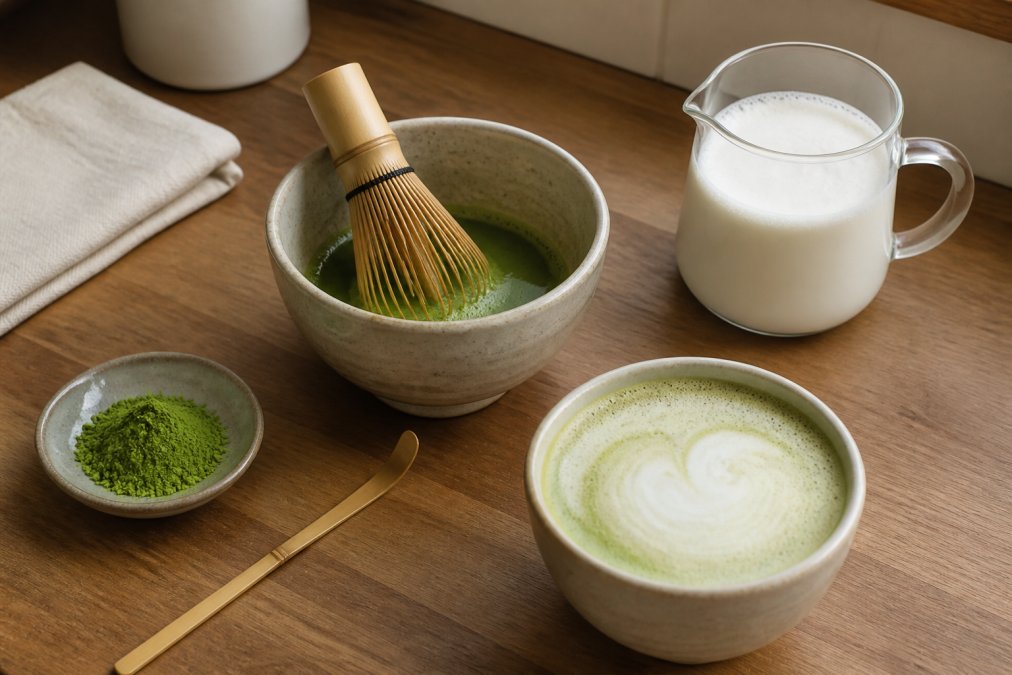
- Sift 1 teaspoon (about 2 grams) of matcha into a bowl to break up clumps
- Add 60ml of water at roughly 80°C, never boiling
- Whisk in a W or zigzag motion for 15-20 seconds until a fine foam forms
- Steam 200ml of your chosen milk to about 65°C
- Pour the milk over the matcha slowly, holding back the foam with a spoon
- Sweeten to taste with panela or coconut sugar if needed
Whisking vs Frothing: Getting the Texture Right
A bamboo whisk, called a chasen, is designed to break up matcha particles and create a fine foam. A milk frother or electric whisk spins faster but tends to introduce larger bubbles and can leave clumps if you don't sift first. If you're using a frother, pulse it in short bursts rather than running it continuously.
The real difference comes down to aeration. Traditional whisking produces a denser, more integrated foam that holds its structure when milk is poured. Frothing produces a lighter, airier foam that collapses faster. For a hot latte, whisking wins. For an iced latte, either works.
Milk Pairing Guide: Dairy, Oat, and Plant-Based Options
The milk you choose changes the entire character of the drink. Full-cream dairy brings natural sweetness and a rich mouthfeel that complements matcha's umami without masking it. Oat milk is the most popular plant-based option because its natural creaminess and mild sweetness pair well with the grassy notes of matcha.
Other options worth knowing:
- Soy milk: Highest protein, holds foam well, but can taste slightly beany against matcha
- Almond milk: Light and nutty, but tends to separate in hot drinks unless it's a barista blend
- Coconut milk: Adds tropical sweetness, best for iced versions
- Macadamia milk: Growing in popularity here, very smooth, but harder to find in barista format
Benefits of Organic Matcha Powder You Can Actually Feel
The benefits of organic matcha powder come primarily from two compounds: L-theanine and catechins. L-theanine is an amino acid that promotes calm alertness, while catechins are antioxidants concentrated in shade-grown green tea leaves. Because matcha is made from whole leaves rather than steeped and discarded, you consume the full spectrum of these compounds.
Many regular matcha drinkers describe the effect as steady focus without the sharp peak and crash of coffee. The caffeine in matcha is released more gradually, which is why it's often recommended for people who want sustained energy through a workday rather than a quick jolt.
Caffeine Content: How Matcha Compares to Your Morning Coffee
A standard serving of matcha contains roughly 60-70mg of caffeine, compared to about 80-100mg in a single espresso (pubmed.ncbi.nlm.nih.gov). The number is lower, but the experience is different. Matcha's caffeine binds with L-theanine, which slows absorption and smooths the curve.
If you're coming from three espressos a day, matcha won't hit the same way in the first 20 minutes. What it does instead is hold you steady for three to four hours without the mid-afternoon dip. Most people who switch find they drink less caffeine overall, not more.
Sustainability and Ethical Sourcing in Japanese Matcha
Shade-grown cultivation is the traditional method for producing high-grade matcha, and it's also one of the more resource-intensive farming practices. Growers cover the tea plants for several weeks before harvest, which reduces photosynthesis and boosts chlorophyll and L-theanine production. The result is the vibrant green colour and sweet flavour that define quality matcha.
Sourcing directly from farms in regions like Kagoshima and Uji shortens the supply chain and supports growers who maintain these methods. Japanese Ministry of Agriculture, Forestry and Fisheries publishes guidance on organic certification for exported tea, which helps buyers verify origin claims.
Price per Cup and What You're Actually Paying For
Price per cup is where the maths gets interesting, and it is also where most buyers make a mistake. A 30g tin of premium matcha at $48.00 works out to $1.60 per gram, or roughly $3.20 per serve at the standard 2g serving size. That is more than a mid-range café coffee but considerably less than a specialty matcha latte bought out, which typically runs $6.50 to $8.50 in most cafés. If you drink one latte a day, a 30g tin lasts about two weeks, so the habit costs roughly $24 a week, less than five café matcha lattes.
What actually drives the price
Four things separate a $48 tin from a $20 tin, and none of them are branding:
- Harvest timing. First-harvest (ichibancha) leaves are picked in late April to May, when the plant has stored the most L-theanine and the least tannin. Later harvests yield more leaf per plant but at lower quality, which is why culinary-grade matcha can cost a third of the price.
- Shade-growing. Growers cover the plants for around 20 to 30 days before harvest, which reduces photosynthesis and boosts chlorophyll and L-theanine. The shading structures, labour, and reduced yield all add cost.
- Stone-grinding. A traditional granite mill produces only around 30 to 40 grams of powder per hour. Industrial ball mills or jet mills can produce many times that, but they generate heat that degrades the delicate aromatics. Genuine stone-ground matcha costs more because the process is slow by design.
- Certification. JAS organic certification requires annual inspection, record-keeping, and separation of organic and conventional leaf through the entire supply chain. That compliance cost is built into the tin.
Comparing cost per serve honestly
Product |
Size |
Price |
Cost per 2g Serve |
|---|---|---|---|
30g |
$48.00 |
$3.20 |
|
30g |
$49.00 |
$3.27 |
|
Typical culinary-grade tin |
100g |
$25.00 |
$0.50 |
Café matcha latte (out) |
1 serve |
$7.00 |
$7.00 |
The culinary-grade row is not a like-for-like comparison, it is there to show what you give up. At $0.50 a serve you are buying a matcha with higher tannin and lower L-theanine, which is why it needs sweetener and why it tastes sharper. The premium tin is not expensive in absolute terms; it is expensive relative to a product that does a different job.

The break-even point
If you currently buy a café matcha latte five days a week, you are spending around $35 a week, or roughly $1,820 a year. A daily home latte made with a $48 tin and barista oat milk (around $4 a litre, or $0.80 per 200ml serve) costs about $4.00 a day, or $1,460 a year. The saving is real but modest, the stronger argument for buying premium matcha is that a $20 tin you don't enjoy is worse value than a $48 tin you finish.
If you want a matcha built specifically for milk drinks, Whisk Away Matcha is the pick. It's stone-ground from shade-grown Kagoshima leaf, JAS Certified Organic, and smooth enough that you don't need to drown it in sweetener to make it drinkable. For something closer to a café-style cup, Cafe Blend Matcha is blended for consistency and holds up well with oat or dairy milk.
Frequently Asked Questions
Which type of matcha is best for lattes?
Latte-grade matcha, sometimes called culinary grade, is blended specifically to hold its flavour against milk. It has a slightly bolder, more robust profile than ceremonial grade, so the matcha taste still comes through once you add steamed milk. That said, a high-quality ceremonial grade also works beautifully in a latte if you prefer a smoother, sweeter cup. Whisk Away Matcha's Café Blend ($49.00) is made for exactly this purpose, while the standard Whisk Away Matcha ($48.00) suits those who want a more traditional flavour.
Is it necessary to buy organic matcha for health benefits?
Organic certification matters because matcha is made from whole shade-grown tea leaves that you consume entirely, not steeped and discarded. Any pesticide residue on the leaf ends up in your cup. JAS Certified Organic matcha is grown without synthetic pesticides or fertilisers, so you get the full benefits of organic matcha powder, including antioxidants and L-theanine, without worrying about what else is in the powder. It is not the only factor in quality, but it is one of the most reliable signals.
How can you tell if matcha powder is high quality?
Look for a vibrant green colour, a fine stone-ground texture that feels smooth between your fingers, and a fresh, sweet aroma with grassy notes. Low-quality matcha tends to look dull or yellowish, clumps easily, and tastes bitter or chalky. Check the origin too: Japanese farms in regions like Kagoshima and Uji are known for shade-grown cultivation and first harvest leaves. Certification such as JAS Organic adds another layer of assurance about purity and sourcing.
How much matcha should I use per latte?
A standard serving is 1 to 2 grams (about half to one teaspoon) per 200ml latte. Start with 1 gram if you are new to matcha or sensitive to caffeine, then adjust upward for a stronger flavour. Whisk the powder with about 30ml of hot water (not boiling, around 80°C) first to dissolve it into a smooth paste, then add your steamed milk. This keeps the texture clump-free and the flavour balanced.