

Why Does My Matcha Taste Bitter? Fix It Fast
Table of Contents
- The Real Reasons Your Matcha Tastes Bitter
- The Best Water Temperature for Matcha (And Why It Matters)
- How to Whisk Matcha Without Clumps (And Avoid Astringency)
- How to Store Matcha Powder to Preserve Freshness
- Is Your Matcha Low Quality? Signs to Look For
- How to Fix Bitter Matcha: Quick Troubleshooting
- Frequently Asked Questions
Last Updated: September 16, 2026
The Real Reasons Your Matcha Tastes Bitter
If you've ever asked yourself "why does my matcha taste bitter", the answer usually comes down to one of three things: water that's too hot, powder that's oxidised or low grade, or a whisking technique that never properly breaks up the clumps. At Whisk Away Matcha, we hear this question constantly from people who've bought decent powder and still ended up with a cup that made them wince.

Here's the good news. Bitterness in matcha is almost always fixable, and it rarely means you need to spend more money. It usually means one variable in your preparation is working against you.
Bitterness in matcha is the sharp, drying sensation caused by tannins and polyphenols being extracted too aggressively, either through heat, poor suspension, or oxidation of the powder itself. A well-made bowl should taste grassy, savoury and slightly sweet, with the astringency sitting in the background rather than dominating.
Below, we'll walk through each cause in order of how often it happens, plus a troubleshooting table you can run through in under a minute.
The Best Water Temperature for Matcha (And Why It Matters)
The best water temperature for matcha is 70-80°C. Anything above 85°C scalds the leaf, pulling out tannins faster than it releases the amino acids that give matcha its sweetness and umami. But temperature is only half the story. The water itself, its mineral content and pH, can make or break your bowl, and almost no guide talks about it.
Why Boiling Water Ruins Matcha
Boiling water sits at roughly 100°C, and that's well past the point where matcha's delicate compounds start breaking down. The heat strips out L-theanine, the amino acid responsible for that calm, focused feeling matcha is known for, while tannins and bitter polyphenols flood into the water instead.
The practical fix is simple. Boil your kettle, then let it sit for two to three minutes before pouring. If you want precision, pour the hot water into your bowl first, then into a second vessel, then back into the bowl. Each transfer drops the temperature several degrees.
For a more consistent result, a variable-temperature kettle removes the guesswork entirely.
The Water Chemistry Angle Most Guides Miss
Even at the perfect temperature, your water can sabotage your matcha. Two factors matter most: mineral content and pH.
Mineral content. Hard water, common in many households, particularly in areas supplied by groundwater, contains high levels of calcium and magnesium. These minerals bind to matcha's tannins and polyphenols, but they also interfere with the extraction of L-theanine and other sweet-tasting amino acids. The result is a cup that tastes flat, chalky, and disproportionately bitter. Soft water or filtered water (using a carbon filter or a jug-style filter) removes some of these minerals and gives you a cleaner extraction. If you live in a hard-water area, this single change can transform your matcha.
pH levels. Matcha extracts best in slightly acidic to neutral water (pH 6.5-7.5). Alkaline water (pH above 8), often sold as "ionised" or "alkaline" water, accelerates the extraction of bitter compounds while muting the umami. If your tap water is alkaline, a simple squeeze of lemon juice (just a few drops) can bring the pH down without affecting the flavour. Conversely, very acidic water (pH below 6) can make the matcha taste sour and thin.
What to do: If your matcha tastes bitter even when you've nailed the temperature, try filtered water. If you want to go further, test your tap water's pH with a cheap aquarium test kit or a digital pH meter. Most people find that switching from unfiltered tap water to filtered water is the single biggest improvement after temperature control.
How to Whisk Matcha Without Clumps (And Avoid Astringency)
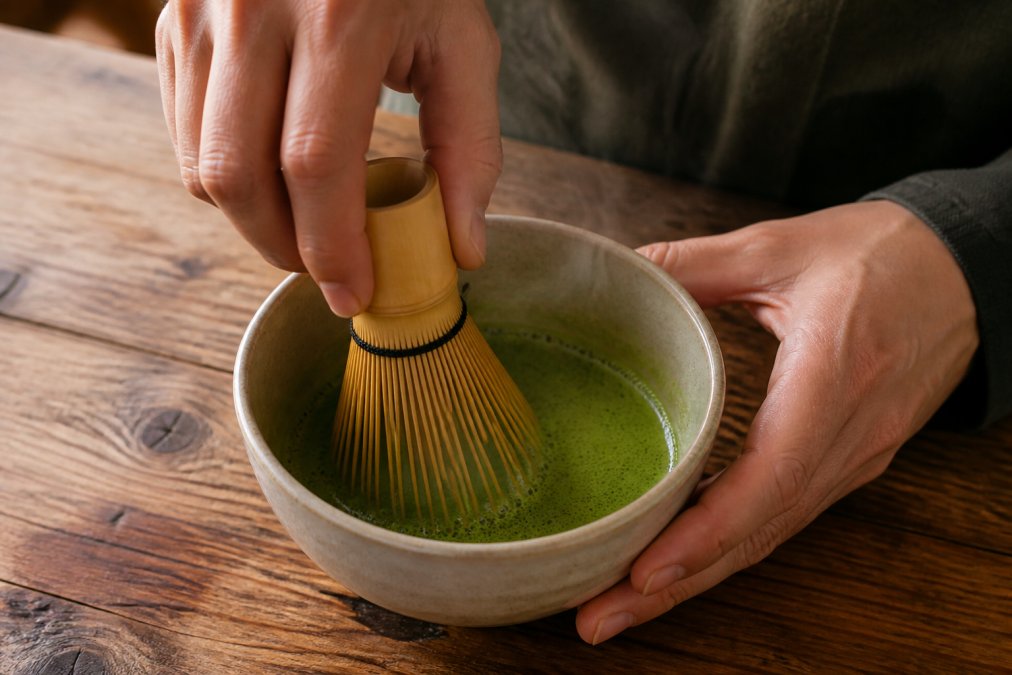
Learning how to whisk matcha without clumps comes down to two things: sifting the powder first, and using a proper zigzag motion rather than a circular stir. Clumps that survive whisking sit as dry pockets in the bowl, and when you drink them they hit your palate as concentrated bursts of astringency.
The Right Technique for a Smooth Bowl
- Sift 1-2 grams of matcha through a fine strainer into your bowl. This alone eliminates most clumping.
- Add 60-70ml of water at 70-80°C.
- Hold the bowl steady with one hand and grip the chasen with the other.
- Whisk in a rapid "W" or "M" motion, moving back and forth rather than in circles.
- Keep the whisk just above the base of the bowl so you're aerating the liquid, not scraping it.
- Continue for 15-20 seconds until a fine, even foam forms across the surface.
That aeration step matters more than most people realise. Whisking introduces air and helps the powder stay in suspension, which spreads the bitter compounds evenly instead of letting them pool.
Equipment Impact: Bamboo vs. Electric Frother
A traditional bamboo whisk, or chasen, has dozens of fine tines designed for exactly this. A fork or a milk frother won't produce the same emulsification. But the difference goes beyond tradition, it's about foam structure and how that structure changes your perception of bitterness.
Bamboo chasen: The tines are flexible and slightly curved, which creates a shear force that breaks up clumps and incorporates air into a fine, stable microfoam. This foam coats your palate and physically blocks some of the bitter compounds from hitting your taste buds. The result is a smoother, sweeter-tasting bowl. A chasen with around 80 tines gives noticeably better aeration than a cheap 40-tine version.

Electric frother: These spin fast and can create a frothy top, but the bubbles are larger and less stable. The foam collapses quickly, and the high-speed spinning can actually over-agitate the matcha, extracting more tannins. The mouthfeel is thinner, and bitterness comes through more sharply. If you must use one, use it on the lowest speed and only for a few seconds.
Fork or spoon: These don't aerate at all. They just stir, leaving clumps and a flat, bitter cup. Not recommended.
The takeaway: If you drink matcha regularly, a bamboo chasen is worth the investment. It's not just about authenticity, it's about the physics of foam and how that foam changes what you taste.
How to Store Matcha Powder to Preserve Freshness
Learning how to store matcha powder properly is the single most overlooked fix for bitterness.
The rules are straightforward:
- Keep it in an airtight container, ideally a sealed tin rather than a bag with a clip.
- Store it in the fridge, away from strong-smelling foods.
- Bring the tin to room temperature before opening it, so condensation doesn't form on the powder.
- Use it within two to three months of opening for the best flavour.
Is Your Matcha Low Quality? Signs to Look For
Signs you're working with poor-quality powder:
- Dull, yellowish or greyish colour rather than vivid green
- A flat, dusty smell instead of a fresh, grassy aroma
- Visible grit or a chalky texture even after whisking
- Bitterness that arrives immediately, with no sweetness underneath
How to Fix Bitter Matcha: Quick Troubleshooting
| Symptom | Likely Cause | Fix | Impact |
|---|---|---|---|
| Sharp, drying bitterness | Water too hot | Cool to 70-80°C | High |
| Gritty, uneven taste | Clumps not sifted | Sift before whisking | High |
| Flat, dull bitterness | Oxidised powder | Replace and store airtight | High |
| Bitter with no sweetness | Culinary grade powder | Switch to ceremonial grade | Medium |
| Harsh aftertaste | Too much powder | Reduce to 1-2g | Medium |
| Thin, watery bowl | Poor aeration | Whisk in a W motion | Medium |
Frequently Asked Questions
Is it okay to drink bitter matcha?
Bitter matcha is safe to drink, but it usually means something went wrong in preparation or storage. Bitterness often comes from water that's too hot, old powder, or low-quality leaves. While not harmful, it won't taste good and you'll miss the smooth umami and natural sweetness of fresh matcha. If your matcha tastes bitter, try lowering the water temperature to about 80°C and whisking more thoroughly. If it still tastes bitter, the powder may be stale or culinary grade.
How to remove bitterness from matcha?
Start by using water at 75-80°C instead of boiling. Sift your matcha powder through a strainer to remove clumps, then whisk in a zigzag motion until frothy. If it's still bitter, add a splash of milk or a natural sweetener like honey. Also check your matcha's freshness: if it's older than a few months or stored improperly, replace it. Using ceremonial grade matcha rather than culinary grade will also reduce bitterness significantly.
How do I know if my matcha is bad?
Signs of bad matcha include a dull, yellowish-green colour instead of vibrant green, a flat or musty smell, and a taste that's overwhelmingly bitter or chalky. Fresh matcha has a sweet, grassy aroma and a smooth, umami-rich flavour. If your powder clumps easily or has lost its bright colour, it's likely oxidised. Proper storage in an airtight container away from light and heat can extend its shelf life to several weeks after opening.
Does water temperature affect matcha bitterness?
Yes, water temperature is one of the biggest factors. Water that's too hot (above 85°C) extracts tannins and polyphenols too quickly, making matcha taste bitter and astringent. The best water temperature for matcha is between 75°C and 80°C. Let boiled water cool for 2-3 minutes before whisking. Using a thermometer helps, but you can also pour boiling water into a cup and let it sit briefly before adding to your bowl.