

Signs of High Quality Matcha: 2026 Visual Guide
Table of Contents
- What Separates High Quality Matcha from the Rest
- Why Is Uji Matcha Considered Premium?
- Ceremonial Grade vs Culinary Grade Matcha
- The 30-Second Sweetness Test and Other Quality Checks
- How to Store Matcha Powder for Freshness
- Red Flags: Oxidation, Fillers, and Fake Matcha
- Making the Choice: What to Look For When You Buy
- Frequently Asked Questions
Last Updated: September 18, 2026
What Separates High Quality Matcha from the Rest
High quality matcha is a stone-ground green tea powder with a vibrant green colour, a smooth texture, and a fresh, grassy aroma. It comes from shade-grown tea leaves and carries natural sweetness instead of bitterness.
This guide from Whisk Away Matcha breaks down the signs of high quality matcha you can check before you buy. Most guides describe colour and taste. Fewer show you how to test it yourself.

That gap matters. A tin can look premium and still hold dull, oxidized powder.
Below, we cover eight checks, from colour to foam to storage, plus the red flags that expose fillers and fakes.
Why Is Uji Matcha Considered Premium?
Uji matcha is considered premium because of its terroir, its long tea-growing history, and careful shading before harvest. Shading boosts chlorophyll and amino acids, which lift colour and sweetness.
The Uji region near Kyoto has produced tea for centuries. Growers there use tencha leaves, grown in shade, then stone-ground into fine powder.
Kagoshima, in southern Japan, is the other region worth knowing. It grows a large share of Japan's tea, and its volcanic soil suits the crop.
Whisk Away Matcha sources its matcha directly from Kagoshima and Uji, Japan. Both are JAS Certified Organic, so you can trace origin and safety.

Ceremonial Grade vs Culinary Grade Matcha
Ceremonial grade matcha is made from the youngest shade-grown leaves and whisked with water alone. Culinary grade matcha comes from later harvests and is built for blending into lattes, baking, and smoothies.
Here is how the two compare:
Feature |
Ceremonial Grade |
Culinary Grade |
|---|---|---|
Leaf age |
Youngest shoots |
Later harvests |
Colour |
Vibrant, luminous green |
Duller, yellow-green |
Flavour |
Sweet, mild umami |
Stronger bitterness |
Best for |
Whisking with water |
Lattes, baking, blends |
Price |
Higher |
Lower |
A common mistake is buying culinary grade for a plain bowl of matcha, then blaming the powder for tasting bitter.
The 30-Second Sweetness Test and Other Quality Checks
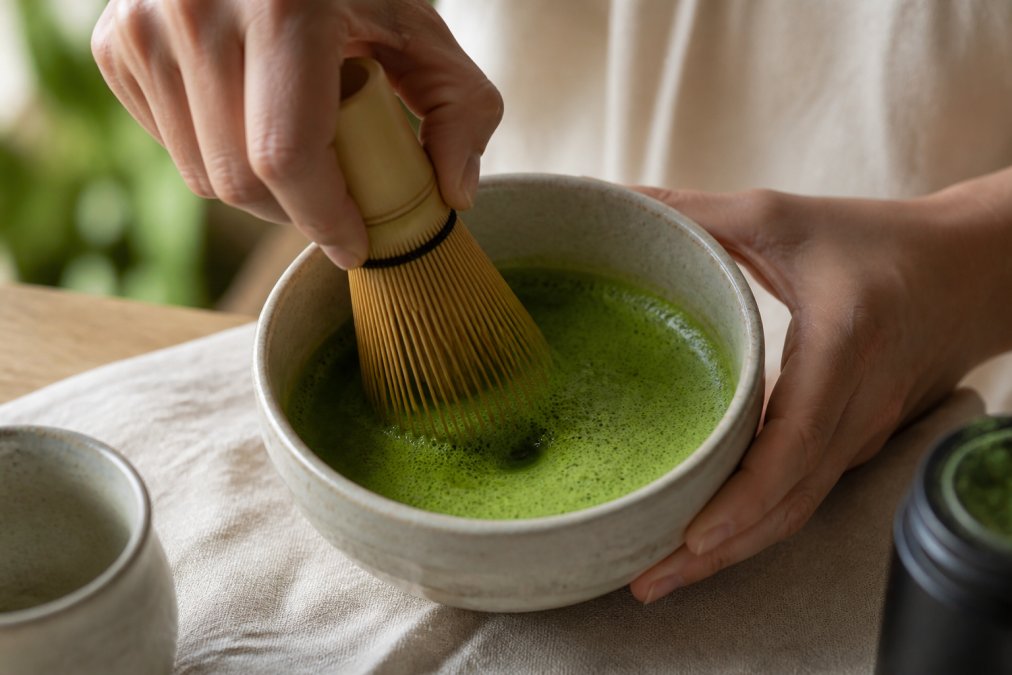
The 30-second sweetness test: whisk one teaspoon of matcha with warm, not boiling, water and taste it after 30 seconds. Good matcha leaves a sweet, umami aftertaste. Poor matcha turns bitter fast.
Why the 30-Second Window Works
The timing is not arbitrary. Matcha's sweetness comes from L-theanine, an amino acid that builds up when tea plants are shaded before harvest. Bitterness comes from catechins, which increase with sun exposure and leaf age. When you whisk matcha in warm water, the sweet compounds dissolve and register on the palate first. Catechins release more slowly and peak as the cup cools.
The Five Sensory Checks, With the Mechanism Behind Each
- Colour test, bright, luminous green means fresh chlorophyll. Dull yellow-brown means the chlorophyll has oxidized to pheophytin, which happens with age, heat, or light exposure. Hold the powder in daylight, not under warm indoor bulbs, which flatter dull powder.
- Texture test, rub a pinch between your fingers. Stone-ground matcha should feel like fine talc, with no grit. Grittiness means a coarser grind, often from a blade mill rather than a granite stone mill, and it will settle rather than suspend in water.
- Aroma test, fresh, grassy and vegetal is right. A dusty, hay-like or cardboard smell is a warning. Aroma fades before colour does, so smell the powder the moment you open the tin, not after it has sat out.
- Sieve test, sift a spoonful through a fine mesh. Clumping points to moisture or age. A dry, free-flowing powder sifts cleanly.
- Foam test, a good whisk should build fine froth, not large bubbles. Small, dense bubbles indicate fresh powder with intact proteins and fine particle size. Big, loose bubbles usually mean stale powder or a weak whisk.
How to Run a Side-by-Side Test
The single most reliable way to judge matcha is to compare two powders in the same session, with the same water, the same whisk, and the same bowl. Sensory memory is short, so a direct comparison removes guesswork.
- Label two bowls A and B. Use one teaspoon of each powder.
- Heat water to roughly 75-80°C and use the same volume in both bowls.
- Whisk each for the same count, around 15 to 20 seconds in a fast W motion.
- Compare in this order: dry colour first, then aroma, then foam, then taste at 30 seconds, then taste again at two minutes.
- Note which one stays sweet longer. The powder that holds its sweetness past the two-minute mark is the higher grade.
Whisking Technique and Foam Quality
Foam quality depends on technique as much as powder. Use a bamboo whisk, or chasen, and move it in a fast W motion, not a circle. A circular motion whips air in without breaking down clumps, which is why beginners often get large, uneven bubbles.
How to Store Matcha Powder for Freshness
To store matcha powder for freshness, keep it airtight, opaque, and cold. Light, air, heat, and moisture are the main enemies of colour and flavour.
Simple storage rules:
- Keep it in an airtight tin, not the open bag.
- Choose an opaque container that blocks light.
- Store in a cool, dry place, away from the stove.
- Refrigerate after opening to slow oxidation.
- Use it within a few weeks of opening for best taste.
What Oxidation Actually Does to Matcha
Oxidation is the reaction between oxygen and the compounds that give matcha its colour and flavour. Chlorophyll, the pigment behind the vivid green, breaks down into pheophytin, which reads as olive, yellow, or brown. At the same time, the delicate grassy aroma compounds evaporate or degrade, and the amino acids that carry sweetness are slowly lost. The result is a powder that looks dull, smells flat, and tastes bitter or cardboard-like even though nothing has "spoiled" in a food-safety sense.
How to Tell If Matcha Has Already Turned
Use these signs to judge whether a powder is still good, rather than assuming it is fine because the tin looks sealed:
- Colour drift, compare the powder to a fresh reference if you can. A shift from bright green to olive or khaki is the earliest reliable sign.
- Aroma loss, open the tin and smell immediately. Fresh matcha smells grassy and slightly sweet. Stale matcha smells like hay, dust, or nothing at all.
- Clumping, powder that clumps or cakes has absorbed moisture, which accelerates oxidation and can introduce off-flavours.
- Flat taste, if the 30-second test gives no sweetness and only bitterness, oxidation has likely progressed past the point of recovery.
- Weak foam, a powder that once foamed well but now produces large, loose bubbles has lost the proteins and fine structure that hold a head.
The False-Negative Problem: When Good Matcha Looks Bad
A high-quality powder can be judged harshly for reasons that have nothing to do with its grade. Two are common.
Red Flags: Oxidation, Fillers, and Fake Matcha
Fake and low-grade matcha is common, and it can be hard to spot by look alone. Watch for these warning signs.
Red flags to check:
- Dull, yellow or brown colour instead of vibrant green
- A gritty or powdery texture rather than silky
- No named origin, no cultivar, no harvest date
- No organic certification such as JAS
- A price that is far below the market for ceremonial grade
- A dusty or stale smell rather than fresh and grassy
Making the Choice: What to Look For When You Buy
If you want a café-style cup at home, the Whisk Away Matcha Cafe Blend is made for lattes. It blends premium Kagoshima matcha with organic ingredients in Australia for a smooth, balanced taste.
Frequently Asked Questions
How can I tell if matcha is real or fake?
Real matcha has a vibrant green colour, a fresh grassy smell, and a smooth texture. Fake or low-quality matcha often looks dull yellow or brown, smells stale, and feels gritty. Check for JAS organic certification and a harvest date on the packaging. If it's very cheap, it's likely culinary grade or mixed with fillers.
Does the colour of matcha indicate its quality?
Yes, colour is one of the strongest visual signs of high quality matcha. Premium matcha is a luminous, vibrant green thanks to chlorophyll from shade-grown leaves. Dull yellow or brown tones suggest oxidation, poor shading, or older leaves. However, colour alone isn't enough; pair it with aroma, texture, and taste checks for a full picture.
What is the difference between ceremonial and culinary grade matcha?
Ceremonial grade matcha is made from the youngest shade-grown tea leaves, stone-ground into a fine powder. It's meant to be whisked with water and drunk straight, offering natural sweetness and umami. Culinary grade matcha comes from later harvests, has a stronger bitterness, and is designed for mixing into lattes, baking, or smoothies.
Why is Uji matcha considered premium?
Uji matcha is considered premium because of its long history of tea cultivation, ideal climate, and careful shading techniques that boost chlorophyll and L-theanine. The region's stone-ground tencha produces a smooth, umami-rich flavour with minimal bitterness. Uji's reputation for quality and tradition makes it a benchmark for high quality matcha worldwide.
Finding genuinely high quality matcha takes more than reading a label. Check colour, texture, aroma, origin, and certification before you commit.
Whisk Away Matcha makes that easy. Every tin is JAS Certified Organic, sourced directly from Kagoshima and Uji, and stone-ground for a smooth, low-bitterness cup. Get started with Whisk Away Matcha and build a calmer daily ritual, one intentional bowl at a time.